Twelve players, four class names
Horde Siege
Horde Siege is the PvE wave mode in Gears of War: E-Day. The store page fields 12 players as three squads of four, and it calls the mode an evolved take on the series' co-op wave survival, set in a city under siege. That city language lines up with the campaign's Kalona nights, but the mode is its own roster: four class names, a player count, and a wave structure. It is not a second copy of the Act 2 briefing. The Coalition's gameplay notes and the Steam listing are the two places the public description actually lives.
The four class names are Assault, Marksman, Medic, and Breacher. Steam lists them and stops. It does not publish a weapon loadout or an ability chart for any class. Repeating a guessed grenade kit or a guessed ultimate would dress up a blank. The plates below keep the names and the fact that the kit chart is absent. World bosses are part of the mode's public pitch on the store listing's Horde language, and the same listing still withholds the boss roster, so no boss name is filled in to decorate a card.
The four names on a squad
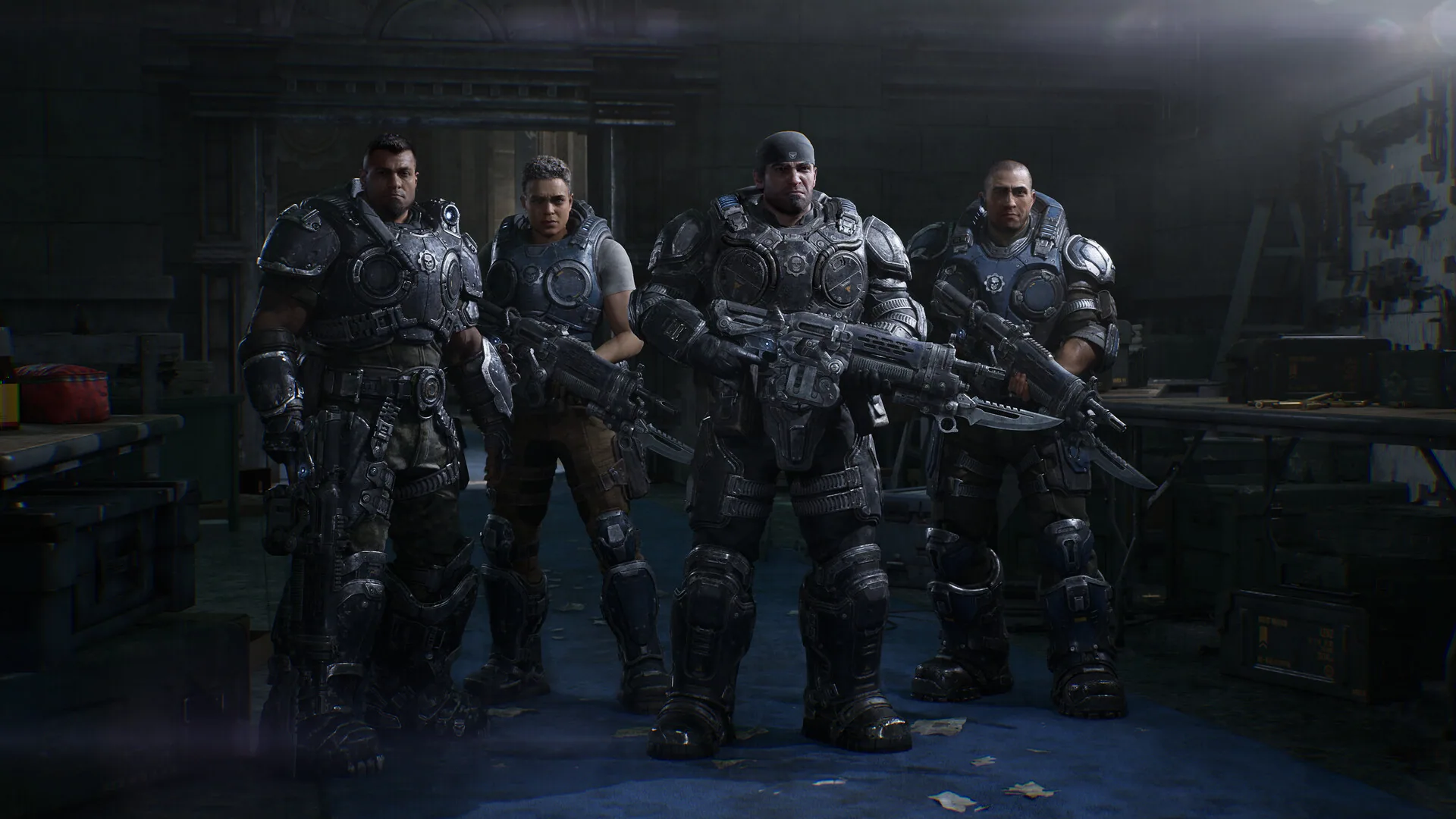
A squad is four players, and the class list is exactly four long, which can be played as one of each name if a group wants the full set. Nothing on the store page requires that mix. It also does not forbid doubled classes. The only hard structure that is printed is the headcount: four in a squad, three squads, twelve in the match. Assault sits first in the printed order used here, then Marksman, Medic, and Breacher. That order is a reading order of the names, not a claim about spawn slots or unlock levels.
Because the kit chart is missing, the useful preparation is the weapon board from the wider game. The Gnasher drops to six shells and can fire during a slide. The Breechshot shares the round-by-round active reload and is described with a one-shot headshot in PvP plus axe executions. Those PvP lines are not automatically the Horde lines. They are the only printed weapon changes, and Horde players will meet the same guns unless a later post separates the sandboxes. Smoke grenades block player and AI sightlines, which is the one note that explicitly mentions AI and therefore matters in a wave mode.
Horde Siege class
·Assault
·First class name printed on the store page.
Horde Siege class
·Marksman
·Second class name printed on the store page.
Horde Siege class
·Medic
·Third class name printed on the store page.
Horde Siege class
·Breacher
·Fourth class name printed on the store page.
Waves, bosses, and what is withheld
The store copy describes surviving a city under siege in a wave mode that is bigger than the old Horde pitch. It does not print wave length, a score formula, a fabricator, or a base-building budget. Season 1's public focus includes launch maps, modes, and cosmetics, and Horde Siege is one of the launch modes, so the maps that exist on October 6 are the maps the first waves use. Ranked, by contrast, is a Versus date: October 13. Horde does not get that ranked date in the season note. Treating Horde as unranked social co-op at launch matches what is written, and it should not be stretched into a ladder.
World bosses are named as a feature in the mode's short description, and then the sources go quiet on species, health, and rewards. The campaign Locust set, Wretches, Drones, Seeders, Boomers, and Reavers, is documented for the story hands-on and the gameplay notes. It is reasonable for a player to expect familiar bodies in a wave mode, and it is not a printed Horde bestiary. Those creatures stay on the Kalona board, where their behaviors are actually described, and Horde stays focused on the 12-player structure and the four class names. When a boss card is printed, it can be added as its own row.
Who can queue on day one
Online co-op on the store page goes up to four players, and Horde Siege's own pitch goes to twelve, so the twelve-player count is the mode rule and the four-player line is the general co-op cap printed beside campaign and Versus. Read them as two sentences from two layers of the listing, not as a contradiction to smooth over. A group of four is the squad size. Three such squads fill a match. Friends who own the game on Xbox Series X|S and Xbox on PC share progression through Xbox Play Anywhere. Steam is a separate Windows build with its own purchase, Standard at $69.99 or Premium at $99.99.
Premium early access starts October 1, 2026 at 8am Pacific. The worldwide launch, and the day Game Pass Ultimate and PC Game Pass include the game, is October 6. Horde Siege is part of the game those clocks unlock. It is not a separate download with its own date in the gold note. The August Open Beta was described around multiplayer, and the weekend 2 PC note required an SSD. That beta is not a promise that every Horde system was in the build players touched. The gold note says PC work continued after the July multiplayer beta. The class names to trust are the ones on the current store page.
Related pages
Sources
Horde Siege on this board is twelve players, three squads, and four class names with the kit chart left off the store page.